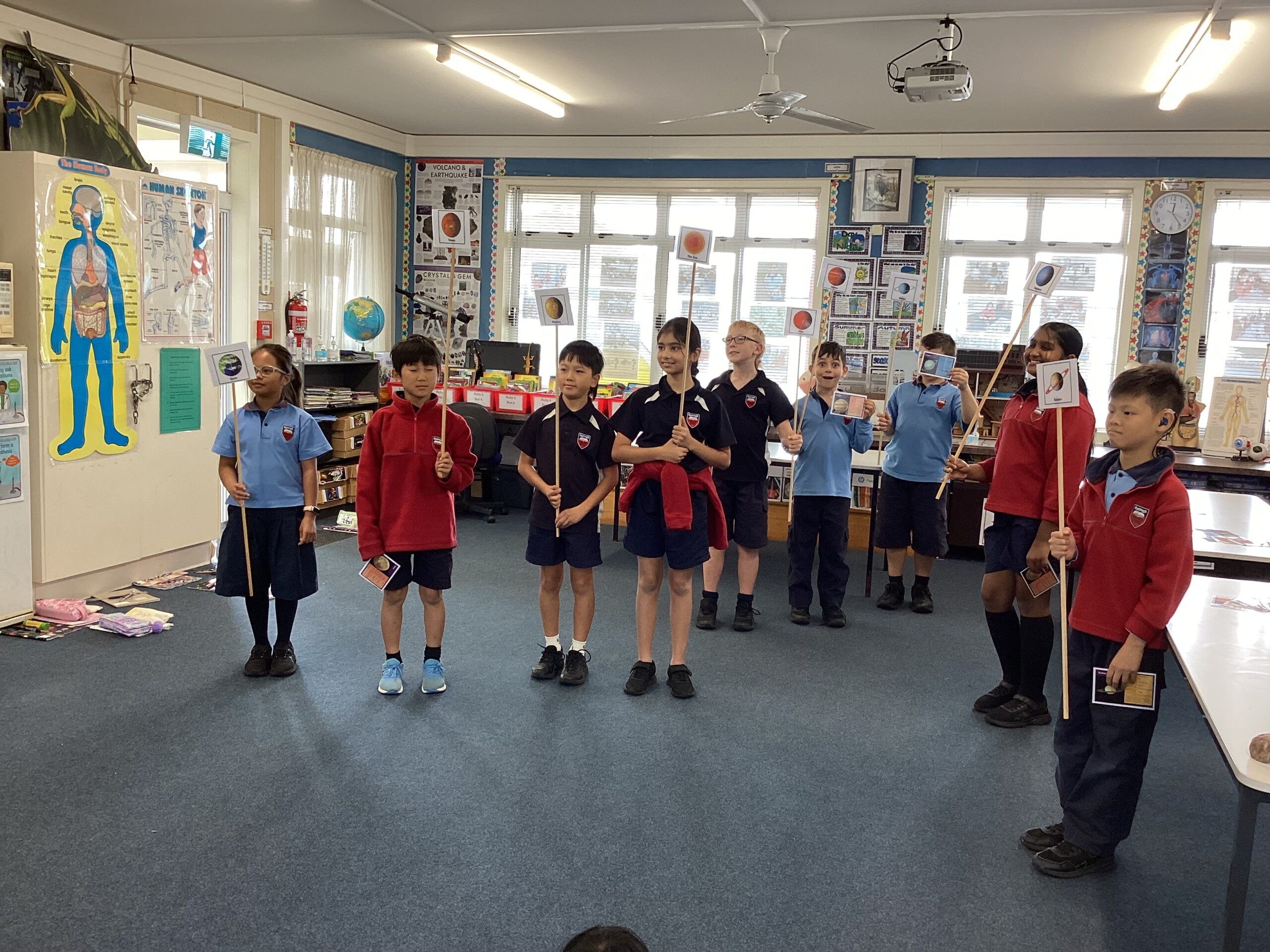
Over the last two weeks in science, our classes have been learning about the Solar System. We explored the planets, the distances between them, and how they move around the Sun. We discovered that the planets are all very different sizes and are made from different materials. The inner planets, such as Mercury, Venus, Earth, and Mars, are rocky planets with solid surfaces. The outer planets, including Jupiter, Saturn, Uranus, and Neptune, are much larger and made mostly of gas and ice.
We also learned some fascinating facts about how planets move. Each planet takes a different amount of time to orbit the Sun, which is why years are different lengths on different planets. We were surprised to learn that on some planets, a day can be longer than a year! For example, Venus spins very slowly on its axis, meaning one day on Venus lasts longer than the time it takes to travel around the Sun. We explored how gravity keeps planets moving in orbit and how scientists use models and simulations to help explain the huge size and scale of the Solar System.
As part of our learning, we went outside and took part in a practical Solar System activity. One student represented the Sun while other students became the planets. We practised being the planets and rotating either clockwise and anticlockwise around the “Sun” to model how planets orbit in space. Some planets moved faster while others moved more slowly, helping us understand why some planets have shorter years and others take much longer to travel around the Sun. This activity helped us visualise the movement and spacing of the planets in a fun and active way.